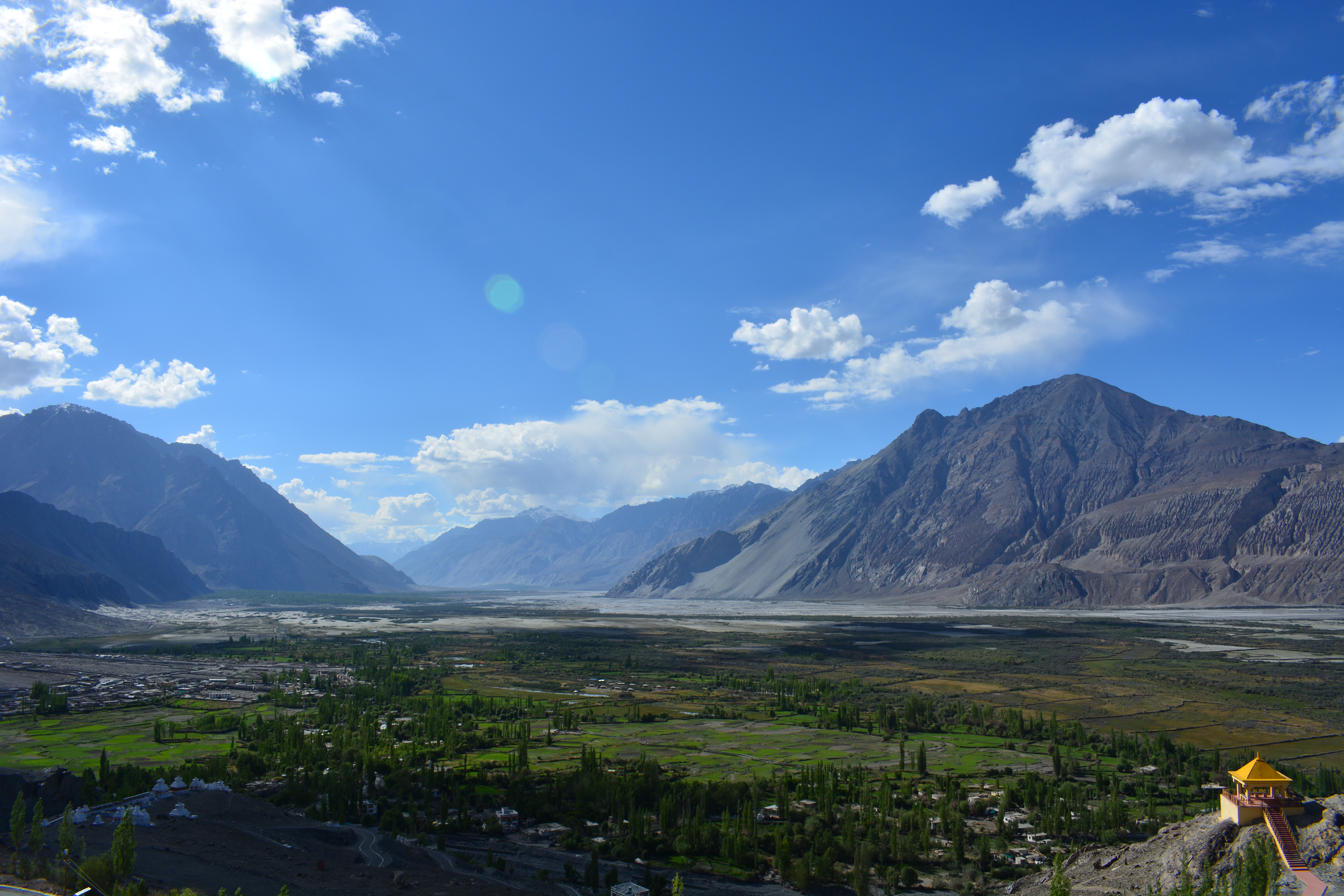
Nubra Valley
ValleyNestled in the remote northern reaches of Ladakh, Nubra Valley is a captivating high-altitude desert landscape often referred to as the "Orchard of Ladakh." Formed by the confluence of the Shyok and Siachen rivers, its stark, moon-like terrain is dramatically contrasted by vibrant green agricultural fields, apricot orchards, and the occasional sand dunes, earning it the nickname "Desert in the Sky.
About Nubra Valley
Nestled in the remote northern reaches of Ladakh, Nubra Valley is a captivating high-altitude desert landscape often referred to as the "Orchard of Ladakh." Formed by the confluence of the Shyok and Siachen rivers, its stark, moon-like terrain is dramatically contrasted by vibrant green agricultural fields, apricot orchards, and the occasional sand dunes, earning it the nickname "Desert in the Sky." The valley is accessed via the formidable Khardung La pass, one of the world's highest motorable roads, making the journey an adventure in itself. Beyond its breathtaking scenery, Nubra offers a glimpse into traditional Ladakhi life, ancient monasteries, and the unique experience of a 'cold desert.' It's a place where majestic mountains, winding rivers, and a rich cultural heritage converge to create an unforgettable travel experience.
History
Nubra Valley has a rich and complex history, once forming part of the ancient Silk Route connecting Ladakh with Central Asia and Tibet. Its strategic location made it a crucial trading hub for commodities like Pashmina wool, carpets, and spices. Evidence of its past can be seen in the ancient monasteries like Diskit and Hunder, which have stood for centuries, witnessing the ebb and flow of empires and cultures. During the 19th century, Nubra, like the rest of Ladakh, became part of the Dogra kingdom of Jammu and Kashmir. Following the partition of India in 1947 and subsequent Indo-Pak wars, a significant portion of the valley, particularly along the Siachen Glacier, became a militarized zone. Despite its geographical isolation, Nubra Valley has maintained its unique cultural identity, heavily influenced by Tibetan Buddhism. The opening of the valley to tourism in recent decades has allowed visitors to experience its untouched beauty and historical significance, while still being a sensitive border area.
Highlights
- Riding the Double-Humped Bactrian Camels in Hunder Sand Dunes
- Visiting Diskit Monastery, the oldest and largest monastery in Nubra
- Admiring the 32-meter-long statue of Maitreya Buddha near Diskit
- Exploring Sumur village and its attractive Samstanling Monastery
- Bathing in the hot springs of Panamik
- Driving over the formidable Khardung La Pass
- Witnessing the confluence of Shyok and Siachen rivers
- Experiencing the tranquil village life in Turtuk (seasonal, requires separate permit)
- Stargazing in the clear night skies of the high-altitude desert
- Sampling local Ladakhi cuisine and apricot products
Visitor Information
Plan your visit to Nubra Valley.
Discover the heritage and culture of India.