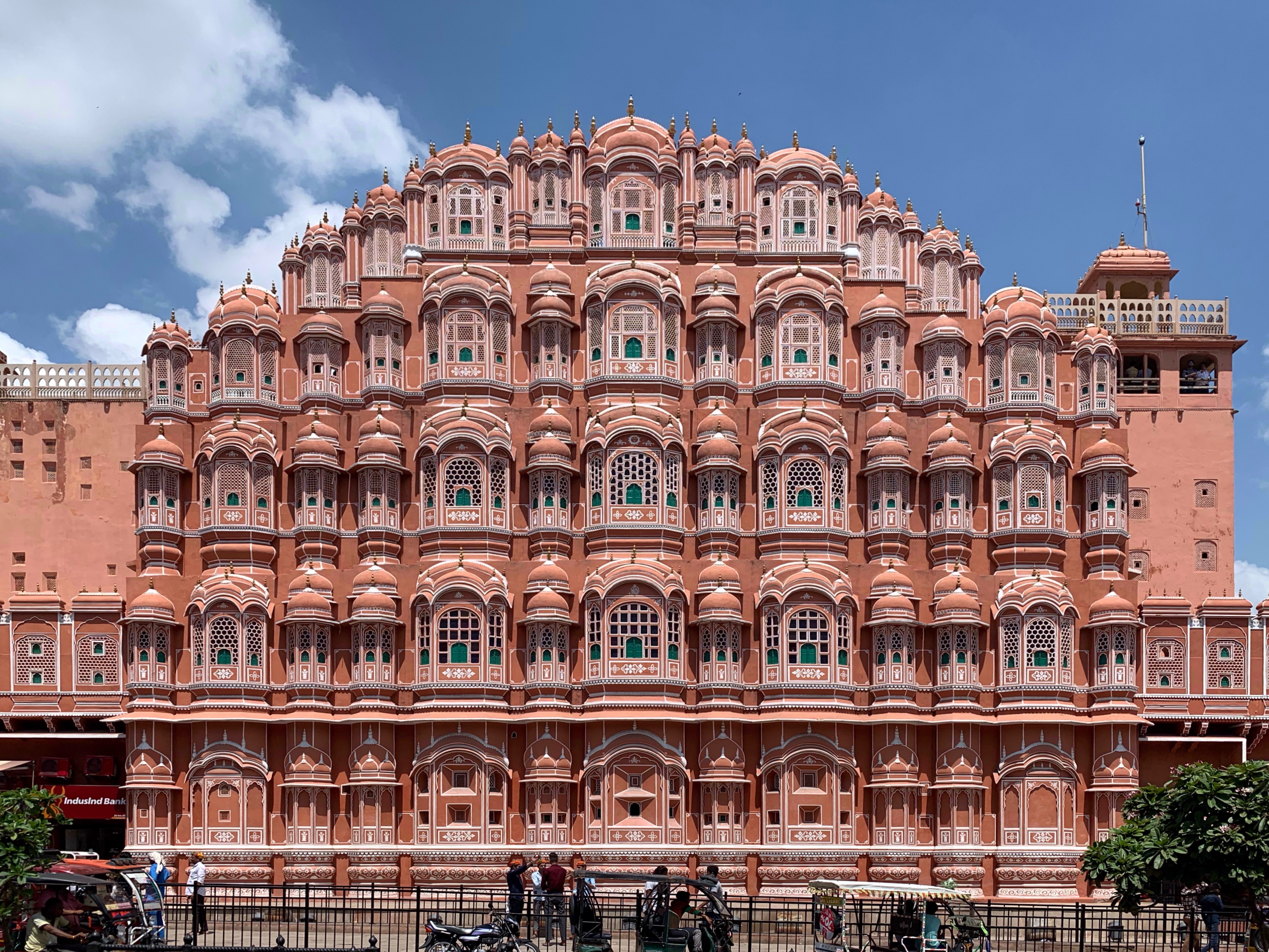
Hawa Mahal
MonumentThe Hawa Mahal, or 'Palace of Winds,' is an iconic landmark in Jaipur, Rajasthan, renowned for its distinctive honeycomb-like facade. Built in 1799 by Maharaja Sawai Pratap Singh, this five-story palace was designed by Lal Chand Ustad.
About Hawa Mahal
The Hawa Mahal, or 'Palace of Winds,' is an iconic landmark in Jaipur, Rajasthan, renowned for its distinctive honeycomb-like facade. Built in 1799 by Maharaja Sawai Pratap Singh, this five-story palace was designed by Lal Chand Ustad. Its primary purpose was to allow the royal ladies to observe everyday life and festivals celebrated in the streets below without being seen themselves, in accordance with the strict 'purdah' system. The palace's unique architectural design incorporates 953 small windows, known as 'jharokhas,' intricately carved with latticework. These windows not only provided a sense of privacy but also allowed a constant flow of cool air, perfectly suited for the hot Rajasthani climate, hence its name. Stepping inside, one finds a series of ramps rather than stairs, facilitating easy movement for palanquins. The Hawa Mahal stands as a testament to the ingenious blend of Rajput and Mughal architectural styles, particularly its vibrant pink sandstone exterior, which contributes to Jaipur's 'Pink City' moniker.
History
Commissioned in 1799 by Maharaja Sawai Pratap Singh, the grandson of Maharaja Sawai Jai Singh, the founder of Jaipur, the Hawa Mahal was an ambitious project driven by a fascinating cultural need. During the late 18th century, the 'purdah' system for royal women was strictly observed, limiting their public visibility. Maharaja Sawai Pratap Singh, a devout follower of Lord Krishna, envisioned a palace that would allow his queens and ladies of the court to witness the grand processions and daily activities on the streets of Jaipur, particularly the vibrant festival of Holi, without being exposed to public view. The architect, Lal Chand Ustad, drew inspiration from the crown of Krishna, designing a five-story structure that strikingly resembles it. The palace is an exquisite example of Rajput architecture, though it incorporates elements of both Hindu and Islamic styles, a common feature in many structures of that era. Despite its elaborate facade, the interior is relatively simple, focusing on the functionality of its ventilation system. The Hawa Mahal has stood for over two centuries as a symbol of Jaipur's rich cultural heritage and architectural ingenuity.
Highlights
- Admire the unique 953 jharokhas (windows)
- Explore the five stories of the palace
- Enjoy panoramic views of Jaipur city from the upper floors
- Witness the intricate latticework and architectural details
- Learn about the 'purdah' system and royal life
- Capture stunning photographs of the pink sandstone facade
- Visit the small museum inside the palace
- Experience the natural air conditioning system
Visitor Information
Plan your visit to Hawa Mahal.
Discover the heritage and culture of India.